The Painting I Cut Apart

Near the end of my final semester in art school, I was struggling with a painting.
It was a large one — about four feet by six feet — and it had slowly become crowded with figures. Faces, performers, fragments of characters. I kept adding to it, trying to make the whole thing make sense. Another detail behind many of the figures in that painting is the puppets.
During art school I discovered that I actually preferred working alone in the studio rather than depending on live models. The models for class were often unreliable, and it was difficult to plan complex compositions around them.
So, I started building my own still lives at home.
I collected puppets and small figures and arranged them under lighting that I controlled myself. This let me create scenes exactly the way I imagined them — almost like setting up a tiny stage. I could move the figures, change the lighting, and paint directly from them whenever I wanted.
Many of the characters that appear in that large painting came from those puppet arrangements. Looking back now, I realize those little staged scenes were already hinting at the theatrical worlds that would later appear in my paintings.
At the time I didn’t feel very confident in what I was doing. I remember staring at the canvas and wondering what the structure of it should be. Should each figure exist in its own separate square? Should I invent some kind of background that would connect them all together? I had no clear answer.
I simply kept painting.
Eventually the painting reached a point where it was finished — or at least finished enough for a student exhibition. It appeared in my graduation show, a large surface filled with disconnected characters and scenes. Looking back at it now, I can see the seeds of many of the images that would appear later in my work.
But at the time I wasn’t thrilled with it.

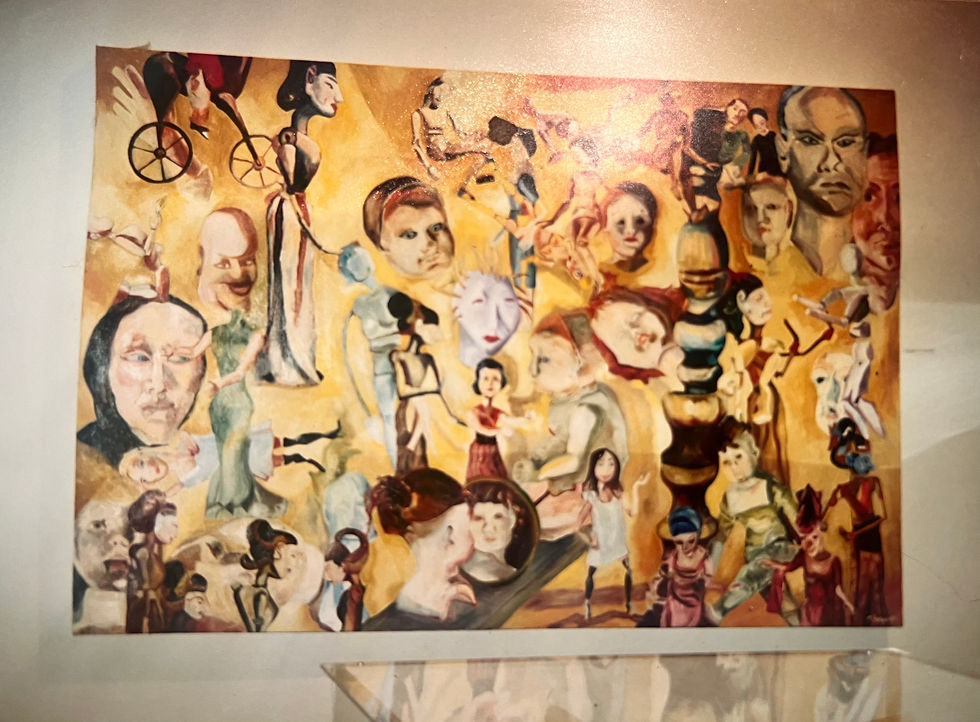
After graduation the painting sat for a while. I lived with it long enough to realize something important: I didn’t love the painting as a whole, but I did love many of the individual figures inside it.
So, one day I did something that might sound a little drastic.
I took the canvas off the stretcher bars and cut it apart.
Instead of one large painting, I began creating a series of smaller works. I carefully cut out the sections that still felt alive to me and mounted them onto boards. Each fragment became its own painting — its own story.
One of the sections I even re-stretched as a separate work, a piece that would later become In the Streets.
Looking at the fragments now, it feels almost as though the painting was never meant to exist as one single image. It was a world trying to break itself into smaller stories.
(Insert photo: the original 4 × 6 painting)
Years later, some of those fragments would become part of my Inner Tales from Oz series. Paintings like The Upside Down carry traces of that original canvas — echoes of a much larger world that once existed inside it.
In a strange way, destroying that painting may have been the moment when several new ones began.
Sometimes paintings don’t disappear.
Sometimes they simply wait to be transformed.
From One Painting to Many
I cut the painting apart according to the several smaller works that I saw. These fragments were either re-stretched onto new supports or mounted on board. This is the way they became individual paintings.
The Upside Down. The Abolishment. In the Streets.
The Inspector. The Acrobat. Madame.
You can see The Upside Down and others in my Tales from Inner Oz Collection.
Some paintings disappear. Others simply transform and return in new forms.
If you like this story and want to hear more Join The Studio at Oz Collectors Circle
--Shannon
The Studio at Oz


Comments